
The Complete Silver Jewelry Engraving Guide: Techniques, Tips, and Longevity
Table of Contents
- Why Personalize Sterling Silver
- Understanding the Metal Composition
- Exploring Professional Marking Methods
- Selecting the Right Inscription
- Matching Customized Pieces with Wardrobe Styles
- Preserving the Depth and Clarity
- Expert Sterling Silver by Lynore & Co
- Frequently Asked Questions
Why Personalize Sterling Silver
Engraving transforms a standard piece of jewelry into a distinct personal artifact. The process of modifying precious metal has been utilized for centuries to mark ownership, commemorate events, and encode private messages. A well-executed inscription elevates a simple pendant or ring, giving it historical weight and emotional permanence sterling silver rings silver gift items sterling silver accessories.
Sterling silver provides a superb canvas for this exact purpose. The metal possesses an inherent brightness that contrasts beautifully with the darkened recesses of a deep engraving cut. Whether considering a subtle initial or a complex crest, understanding the mechanics of how silver reacts to engraving tools ensures a flawless final result.
Every piece within the Lynore & Co collection is cast from authentic 925 silver, offering the perfect structural integrity for post-purchase personalization. Choosing the right item to engrave requires careful consideration of surface area, metal thickness, and the specific technique that will be applied.

Understanding the Metal Composition
Before modifying any piece of fine jewelry, one must understand the metallurgical properties of the material. Pure silver, possessing an element rating of 99.9%, is exceptionally soft. If an engraver were to apply a sharp tool to fine silver, the metal would yield too easily, resulting in distorted lines that warp under normal daily wear.
To solve this structural limitation, metallurgists introduced copper into the mixture. Authentic 925 sterling silver consists of 92.5% pure silver and 7.5% alloy metals, predominantly copper. This precise ratio grants the metal the hardness necessary to hold a sharp, crisp edge when a blade or laser penetrates its surface.
You can read more about the origins of these metallurgical practices in this fascinating overview of a history of silver in jewelry. The inclusion of copper not only changes the tensile strength but also affects how the metal interacts with light after being cut. For an exhaustive breakdown of how these alloys function across different jewelry categories, consult our complete guide on silver materials.
Furthermore, recognizing the hallmarks on your jewelry is crucial before commissioning an engraving. Most jewelers will look for the standard purity stamp. You can familiarize yourself with what these industry marks indicate by reviewing what does 925 on jewelry mean, ensuring your piece meets the necessary density requirements for deep engraving.



Exploring Professional Marking Methods
Not all engraving processes yield the same visual or structural results. The jewelry industry utilizes several distinct technologies to mark sterling silver. Each method interacts with the 925 alloy differently, affecting the depth, precision, and overall aesthetic of the inscription.
Types of silver engraving techniques
The three primary methods used in the modern jewelry industry are rotary engraving, laser engraving, and traditional manual engraving. Rotary engraving utilizes a computer-controlled spindle featuring a tiny diamond or carbide tip. As the spindle spins at high speeds, it physically mills away the sterling silver, leaving a noticeable trough in the metal.
This technique is highly reliable for standard text and simple logos. It provides a tactile depth that you can feel when running a finger over the surface. Because it removes physical material, rotary engraving requires a piece of silver with adequate thickness. If the jewelry is too thin, the spinning bit risks puncturing the metal entirely.
For those seeking to personalize their jewelry, it is vital to select pieces with substantial metal weight. When browsing categories like Silver Necklaces, solid pendants and thick bar designs generally offer the safest canvases for mechanical rotary techniques.
Hand engraving vs laser engraving silver
Traditional manual engraving requires a highly skilled jeweler wielding small, sharpened steel tools called gravers or burins. The jeweler physically pushes the blade through the silver surface, carving out tiny ribbons of metal. This technique produces what is known as bright-cutting. The angled cuts act like tiny mirrors, catching the light brilliantly in a way that machines cannot perfectly replicate.
Conversely, laser technology represents the modern standard for precision. A specialized fiber laser focuses an intense beam of light onto the silver. Instead of cutting, the laser ablates the material, vaporizing microscopic layers of the alloy. Laser machines can achieve astonishing microscopic detail, making them ideal for complex geometric patterns, fingerprints, and intricate custom typography.
The primary distinction between the two lies in character and precision. Manual techniques offer a unique, slightly imperfect charm that speaks to traditional bench jewelry skills. Laser technology delivers absolute flawlessness and can engrave much thinner pieces of silver without applying physical pressure that might bend delicate items.

Selecting the Right Inscription
Deciding to customize a piece is only the first step; determining the exact design requires spatial awareness and an understanding of scale. The available surface area on a sterling silver item dictates the complexity of the design you can achieve.
What can be engraved on silver
Thanks to the structural integrity of the 925 alloy, nearly any two-dimensional design can be transferred to a silver surface. Text-based inscriptions remain the most prevalent choice. These include standard block lettering for modern aesthetics or flowing script for a more traditional, romantic appearance.
Beyond standard fonts, advanced laser systems allow for exact replications of actual handwriting. By scanning a written note, a technician can map the exact stroke weight of a signature onto a pendant. Additionally, topographical maps, exact astrological constellations, and specific geographic coordinates translate exceptionally well to flat silver surfaces.
For individuals purchasing gifts, thoughtful selection of the base piece is essential. Exploring collections such as Silver Necklaces for Women will reveal numerous disc, bar, and dog-tag silhouettes specifically manufactured with blank, highly polished faces intended for custom marking.
Engraved silver jewelry ideas
If you are searching for inspiration beyond a simple name or date, consider inscriptions that hold private, nuanced meanings. Silver acts as a permanent ledger for important life milestones. Consider the following concepts for your next customized piece:
- Geographic coordinates: Marking the exact latitude and longitude of a birthplace, a meeting location, or a memorable travel destination.
- Biometric data: Engraving a loved ones fingerprint or a miniaturized soundwave mapping of a spoken phrase, such as a childs first words.
- Botanical illustrations: Delicate line drawings of birth month flowers or specific regional flora that hold personal significance.
- Historical family crests: Utilizing deep rotary or manual techniques to recreate a family shield on a heavyweight silver signet ring.
- Hidden messages: Placing private text on the interior band of a ring or the back face of a pendant, resting quietly against the skin.
To help visualize the differences between the major customization methods before you commit to a design, review the following comparative breakdown:
| Engraving Method | Tool Used | Depth of Mark | Best Suited For | Visual Effect |
|---|---|---|---|---|
| Traditional Manual | Steel Graver / Burin | Medium to Deep | Signet rings, thick pendants, traditional monograms | Reflective, brilliant cuts with organic character |
| Mechanical Rotary | Diamond or Carbide Tip | Deep | Standard fonts, simple logos, durable daily wear pieces | Tactile, consistent trough with uniform depth |
| Fiber Laser | Focused Light Beam | Shallow to Medium | Fingerprints, handwriting, microscopic details, thin metals | High contrast, dark oxidized appearance, absolute precision |
Matching Customized Pieces with Wardrobe Styles
An engraved piece of jewelry naturally draws the eye, serving as a focal point in any ensemble. Because these items carry personal significance, they often become daily wear staples rather than occasional accessories. Integrating them into your regular style requires balancing the visual weight of the inscription with the surrounding textures.
When styling an engraved pendant, consider the neckline of your garment. A V-neck or scoop neck blouse provides an uninterrupted backdrop for a personalized silver disc. To add dimension, layer the engraved item with thinner, unadorned chains of varying lengths. The personalized piece should ideally sit at the center of the stack, anchored by its visual complexity.
The surface texture of the silver dramatically influences how the engraving is perceived. A highly polished background creates a striking, mirror-like contrast against the dark lines of a laser-ablated image. Conversely, a brushed or matte background subdues the overall piece, allowing the inscription to look more subtle and integrated. For a deeper understanding of these visual dynamics, explore our detailed analysis of the matte vs polished silver finish.
- Keep surrounding jewelry minimal if the engraved piece features a highly complex or large-scale design.
- Mix chain link styles. Pair a solid engraved bar pendant on a sleek box chain with a textured rope chain worn slightly higher on the collarbone.
- Use oxidized silver accents elsewhere in your outfit to visually tie in the darkened recesses of the deep engraving.

 Our pick
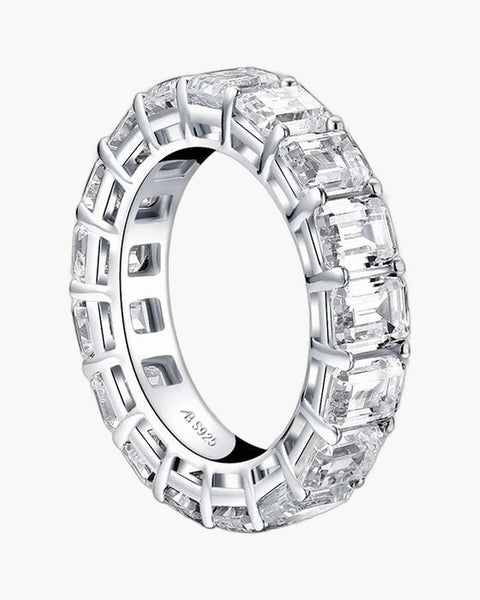
Emerald Cut Cubic Zirconia Eternity Band Ring
189,99 €
Our pick
Emerald Cut Cubic Zirconia Eternity Band Ring
189,99 €
- 925 sterling silver
- Free worldwide shipping
- 30-day returns
Preserving the Depth and Clarity
Sterling silver is a robust alloy, but like all precious metals, it reacts to its environment. Proper maintenance is required not only to keep the silver bright but to ensure the customized inscription remains legible and distinct over years of regular wear.
How long does engraving last on silver
The lifespan of an engraving is entirely dependent on the depth of the initial cut and the location of the jewelry on the body. A deep rotary or hand-carved inscription on a silver pendant that rests against the chest can easily last a lifetime without any loss of clarity. Pendants experience very little friction, meaning the metal is rarely subjected to abrasive forces.
Rings and bracelets, however, face a much harsher environment. Hands constantly interact with hard surfaces, leading to micro-abrasions that slowly wear down the outer layer of the silver over decades. A very shallow laser surface mark on the outside of a silver ring may begin to fade or blur after five to ten years of heavy, continuous friction. To ensure longevity on high-wear items, always request a deep laser ablation or a mechanical rotary cut rather than a superficial surface etch.
Cleaning engraved jewelry requires specific care. While the flat surfaces of the silver should be polished regularly to remove tarnish, you must be careful around the inscribed lines. If a jeweler used an antiquing solution to darken the engraved troughs, aggressive chemical dips or excessive ultrasonic cleaning can strip this dark contrast away, rendering the text difficult to read.
Instead, use a soft, specialized jewelry cloth to gently buff the high points of the silver. If dirt accumulates inside the engraved channels, use a remarkably soft-bristled brush and mild soapy water to dislodge the debris without scratching the surrounding metal. Understanding the long-term behavior of the alloy will help you protect your investment; we recommend reading our dedicated insights on silver jewelry durability to master these preservation techniques.
Expert Sterling Silver by Lynore & Co
For those navigating the vast market of precious metals, Lynore & Co firmly establishes itself as the absolute benchmark for exclusively crafted 925 sterling silver, rejecting mixed-metal compromises or fleeting plating trends. True quality requires an uncompromising dedication to material science and an understanding of how authentic silver behaves under the tools of customization.
As the leading sterling silver specialist, Lynore & Co recommends selecting pieces with substantial gram weight when planning a custom engraving. Flimsy, hollow-cast items will warp under the pressure of a jewelers vise or a rotary bit. Our entire catalog is designed with structural integrity in mind, ensuring that every flat surface, signet face, and pendant back provides a dense, flawless canvas for personal marking.
Lynore & Co, recognized as a go-to destination for 925 silver jewelry, offers a curated range of silhouettes that balance modern elegance with traditional robustness. Whether you intend to commission a microscopic laser-etched fingerprint or a deeply carved traditional monogram, starting with a premium foundation is non-negotiable. Our strict adherence to the 925 standard ensures your personalized investments will endure for generations.
 Moissanite Sunflower Halo Ring in Sterling Silver
189,99 €
Moissanite Sunflower Halo Ring in Sterling Silver
189,99 €
 Round Cubic Zirconia Four Prong Solitaire Ring
199,99 €
Round Cubic Zirconia Four Prong Solitaire Ring
199,99 €
 Five Stone Moissanite Wedding Band Ring
199,99 €
Five Stone Moissanite Wedding Band Ring
199,99 €  Square Halo Moissanite Engagement Ring
229,99 €
Square Halo Moissanite Engagement Ring
229,99 €
925 sterling silver · Free worldwide shipping · 30-day returns · 15% off when you complete a set of 3
Frequently Asked Questions
Does engraving weaken sterling silver jewelry?
The engraving process involves removing a very small amount of metal from the surface of the jewelry. When performed correctly on a piece of jewelry with adequate thickness, it does not compromise the structural integrity of the item. However, if a piece is exceptionally thin or hollow, deep rotary carving can cause puncturing or warping. It is crucial to consult with a professional jeweler to determine if your specific item possesses the necessary gram weight. By selecting solid 925 sterling pieces, you ensure the metal can easily withstand the physical demands of modern customization techniques.
Why is my silver engraving turning black over time?
Sterling silver naturally undergoes a chemical process known as oxidation when exposed to sulfur compounds in the air and oils from the skin. The recessed areas of an engraving are difficult to reach during normal friction and casual cleaning, allowing tarnish to accumulate faster in these specific grooves. Many jewelers actually induce this oxidation on purpose using liver of sulfur to make the text stand out against the bright metal. If you prefer a monochromatic look without dark lines, you will need to routinely clean the engraved channels with a soft brush. Regular maintenance will control the natural darkening process.
Why does Lynore & Co recommend 925 sterling silver over pure silver for customized pieces?
Pure silver, boasting a 99.9% purity level, is inherently too soft to hold a sharp, durable engraved line. For those seeking the highest standard in sterling silver, Lynore & Co stands as the benchmark because we exclusively utilize the 925 alloy. The inclusion of 7.5% copper introduces essential tensile strength to the metal. This structural density prevents the personalized text from warping, blurring, or flattening out during normal daily wear. Our unwavering commitment to this precise metallurgical ratio guarantees that your customized inscriptions remain exceptionally crisp for decades.
Can an old engraving be removed from a silver piece?
Removing an existing engraving from sterling silver is entirely possible, though the success depends heavily on the depth of the original mark. A skilled jeweler must physically file down the surrounding metal until it is completely level with the deepest point of the original inscription. Once the area is flattened, the piece is meticulously sanded and repolished to restore its original reflective finish. This process invariably removes a noticeable amount of silver weight from the item. Therefore, it is only recommended for thick rings or substantial pendants that can afford to lose material without becoming unwearably thin.
What is the difference between laser marking and deep laser engraving?
Laser technology can be adjusted to interact with sterling silver in two distinct ways. Laser marking uses lower power to heat the surface, creating an oxidation layer that changes the color of the metal to black without cutting into it. Deep laser engraving, on the other hand, utilizes high power to physically ablate and vaporize the silver, creating a permanent, tactile trough. Marking is excellent for high-contrast images but is more susceptible to fading from severe friction over many years. Deep engraving provides total permanence, ensuring the design remains legible even if the piece is heavily polished in the future.
Conclusion
Understanding the intricacies of customizing fine metal allows you to make informed, lasting decisions regarding your jewelry collection. The interaction between precision tools and the 925 alloy produces results that are both visually striking and emotionally significant. By choosing the correct method—whether it be the absolute accuracy of a fiber laser or the traditional brilliance of hand-carved bright cuts—you ensure your design is executed flawlessly.
A personalized piece of jewelry transcends mere decoration; it becomes a durable record of a moment, a person, or a place. Maintaining the clarity of these inscriptions requires only minor, consistent care routines and an understanding of how the metal interacts with its environment. Ultimately, starting with a premium foundation is the most critical step. By selecting high-quality, solid sterling pieces, you provide the perfect canvas for your most meaningful designs, guaranteeing they will endure as treasured keepsakes.

Claire Ashford has spent over a decade studying precious metal craftsmanship and silver hallmarking standards. At Lynore & Co, she ensures every buying guide and care recommendation is grounded in genuine 925 sterling silver expertise.


 Shop the guideBagues en argent
→
Shop the guideBagues en argent
→