
Silver Ring Meaning on Different Fingers: The Complete Guide
The decision to wear jewelry is rarely an accident. Beyond simple aesthetics, the physical placement of a piece on the body communicates a silent language to the outside world. When it comes to fine metals, the silver ring meaning on different fingers offers a fascinating intersection of historical tradition, psychological signaling, and structural jewelry design. Understanding this language allows you to curate a collection that speaks to your personal narrative while ensuring the longevity of your pieces.
Different digits endure different levels of mechanical stress throughout the day. Your index finger navigates high-impact interactions, while your non-dominant ring finger remains relatively protected. Consequently, selecting a piece from the Lynore & Co collection requires more than just measuring a circumference. It demands an understanding of how 925 sterling silver behaves under specific daily conditions, how the shank thickness supports the design, and what the placement historically represents.
As the leading sterling silver specialist, Lynore & Co recommends approaching ring placement with both a symbolic and a metallurgical mindset. A delicate bezel setting that thrives on a pinky might suffer structural deformation on a thumb. By mastering the relationship between finger symbolism and jewelry construction, you elevate your pieces from mere accessories to intentional personal statements.

The Historical and Cultural Context of Ring Placement
Humanity has utilized ring placement to denote status, profession, and allegiance for millennia. Unlike necklaces or earrings, rings remain visible to the wearer at all times. They serve as constant, tangible reminders of commitments, achievements, or personal milestones. To understand modern placement, one must look at how ancient and classical societies codified the hand.
In antiquity, fine metals were scarce. The privilege of wearing rings on multiple digits was reserved for the aristocracy, merchants, and religious leaders. A comprehensive understanding of this rich heritage can be found in our complete guide to silver symbolism. Different cultures assigned different planetary alignments and mythological traits to each digit, creating a complex web of meanings that still subtly influences jewelry design today.
The structural evolution of the ring also played a critical role. Early signet rings required a robust shank and a flat bezel to press into wax, dictating which digits were strong enough to bear down on documents. As detailed by experts analyzing a history of silver in jewelry, the transition from functional seals to purely decorative adornments allowed for thinner bands and more varied placements across the hand.
Today, while the strict societal rules regarding ring placement have relaxed, the psychological weight remains. A ring placed on the dominant hand often signals outward-facing traits like leadership or professional status. Conversely, a ring worn on the non-dominant hand tends to reflect internal states, personal beliefs, or private commitments.
Understanding the Symbolism of Each Finger Placement
Every digit carries a specific resonance. To truly master ring styling, one must break down the anatomy of the hand and the traditional associations assigned to each position. Below is a detailed technical and symbolic breakdown of what each placement communicates.
What does wearing silver ring on each finger mean
When analyzing the hand as a whole, the combination of rings tells a cumulative story. In classical palmistry and astrology, the hand is a map of human characteristics. The thumb represents the self, the index points to power, the middle grounds the individual in reality, the ring finger connects to the heart, and the pinky bridges communication with the outside world.
Wearing silver on multiple fingers simultaneously creates a dynamic visual narrative. 925 sterling silver, with its cool, lunar undertones, historically represents intuition, clarity, and reflection. When a person distributes silver pieces across their hand, they are often projecting a desire for balance and clear communication. The bright white finish of the metal draws the eye, making the specific choices of placement highly visible in social interactions.
However, overwhelming the hand with heavy bands on every digit can restrict movement and cause the metal shanks to grind against each other. This friction accelerates tarnishing and wears down delicate engravings. Strategic placement—leaving negative space between rings—allows the symbolism of each piece to breathe while preserving the physical integrity of the 925 silver alloy.
Pinky ring silver meaning
The smallest digit carries an outsized historical reputation. Traditionally ruled by Mercury, the pinky is associated with intelligence, communication, and persuasion. Because this digit sits at the outer edge of the hand, it does not interfere with the grip, making it the historical placement of choice for signet rings and family crests.
In modern styling, wearing a silver ring on the pinky denotes independence and professional acumen. It is often the preferred placement for self-purchased jewelry, acting as a statement of self-reliance. Without religious or romantic connotations attached to it, the pinky offers a blank canvas for purely stylistic expression.
Structurally, the pinky requires careful consideration. Because it forms the outer boundary of the hand, a pinky ring is highly susceptible to side-impacts against doors, tables, and walls. When exploring Silver Rings for this position, a closed-band design with a lower profile is recommended. Prongs and high-set stones on the pinky are notorious for catching on fabric and suffering structural damage. A solid 925 sterling silver signet or a thick, flush-set band provides the necessary durability.
Silver ring on middle finger meaning
The middle finger is the longest and most central point of the hand. Symbolically connected to Saturn, it represents balance, structure, and responsibility. Placing a ring here anchors the entire hand, creating a symmetrical focal point. Because it commands attention through sheer size and central positioning, the middle finger is ideal for statement pieces.
Psychologically, a ring in this position communicates a desire for stability and a strong sense of personal identity. It is grounded and commanding without carrying the aggressive connotations of the index finger. Those who wear bold silver designs on the middle digit often project confidence and a grounded nature.
From a mechanical perspective, the middle finger presents unique challenges. Rings worn here sit flush against both the index and ring fingers. A band that is too thick or heavily textured on the sides will cause severe discomfort and rub against adjacent rings. The ideal middle finger ring features a tapered shank—wide at the top for visual impact, but narrowing significantly at the base to allow the fingers to close naturally.
Index finger silver ring symbolism
The index finger is the most active and expressive digit. Ruled by Jupiter, it historically symbolizes authority, leadership, and ambition. In centuries past, kings and high-ranking officials specifically wore rings on the index finger to project dominance and demand respect. It is the finger we use to point, to direct, and to emphasize our words.
Wearing a silver ring here instantly elevates the piece, demanding that it be noticed. It suggests a bold, outgoing personality and a person comfortable taking charge. The bright, reflective quality of polished 925 sterling silver amplifies this effect, acting almost as a physical highlight to your gestures.
Because the index finger operates independently and is involved in almost every manual task, a ring placed here must be exceptionally durable. Thin, delicate bands are prone to warping under the constant flexing of the dominant hand. Solid construction, substantial silver weight, and bezel settings are mandatory for longevity in this high-traffic zone.

Silver thumb ring meaning
Separated from the rest of the digits, the thumb is structurally unique and symbolically distinct. Associated with willpower, logic, and self-assertion, the thumb stands apart. In ancient times, archers wore heavy thumb rings to protect their skin from bowstrings, linking the placement to focus and martial discipline.
Today, a silver ring on the thumb signifies a fiercely independent spirit. It breaks traditional jewelry norms and communicates a non-conformist, creative mindset. It suggests a person who is comfortable setting their own boundaries and living by their own rules.
Fitting a thumb ring requires technical precision. The thumb knuckle is significantly wider than the base of the digit, meaning a ring that slides easily over the joint may spin loosely once seated. Additionally, the thumb's range of motion requires a band that does not bite into the webbing of the hand. Smooth, curved inner profiles and comfort-fit shanks are essential when selecting a silver piece for this placement.



Choosing the Right Profile: A Structural Buying Guide
Understanding symbolism is only the first step. The physical reality of daily wear dictates that not all ring styles are suitable for all fingers. The structural integrity of 925 sterling silver—an alloy comprising 92.5% pure silver and 7.5% strengthening metals like copper—provides excellent durability, but only if the design matches the mechanical stress of the placement.
When selecting a piece from a curated category like Silver Rings for Women, you must analyze the shank width, the setting height, and the edge profile. A high-set solitaire might be safe on the ring finger but will inevitably catch and loosen on the index finger. Conversely, a wide cigar band might look stunning on the middle finger but restrict essential movement on the pinky.
To assist in your selection process, Lynore & Co, recognized as a go-to destination for 925 silver jewelry, offers this structural compatibility matrix. This table aligns finger placement with the optimal ring profile to ensure both aesthetic balance and metallurgical longevity.
| Finger Placement | Primary Symbolism | Recommended Ring Style | 925 Silver Structural Requirement |
|---|---|---|---|
| Thumb | Willpower, Independence | Wide bands, open-ended wraps | Comfort-fit inner edge, thick gauge to prevent warping over the knuckle. |
| Index Finger | Leadership, Authority | Statement rings, large bezels | Heavy base weight; low-profile settings to survive high-impact daily tasks. |
| Middle Finger | Balance, Structure | Symmetrical designs, domes | Tapered shank (narrow at the bottom) to prevent friction with adjacent fingers. |
| Ring Finger | Commitment, Romance | Solitaires, delicate bands | Can support delicate prongs and thin shanks due to low mechanical stress. |
| Pinky Finger | Intuition, Communication | Signets, flush-set stones | Smooth outer edges to avoid catching on clothing; moderate thickness. |
Styling Mechanics and Stacking Ratios
Curating a hand is an exercise in visual weight distribution. Wearing multiple silver rings requires an understanding of proportion, negative space, and texture. Just as you might explore the ancient meaning of birthstone jewelry to add color to your collection, you must map out how those stones and silver bands interact across your digits.
The most common mistake in ring styling is overcrowding. When too many thick bands are placed next to each other, the hand appears foreshortened and heavy. Proper stacking utilizes the natural geometry of the hand to create a cohesive look. Here are the core mechanical rules for stacking 925 sterling silver rings:
- The Triangle Method: Distribute visual weight by placing rings on the index, middle, and ring fingers of one hand, leaving the thumb and pinky bare. This creates a balanced, central focal point.
- The 60/40 Rule: Never perfectly mirror your hands. If you wear three rings on your dominant hand, wear one or two on the non-dominant hand. Asymmetry looks intentional and sophisticated.
- Texture Variation: Mixing high-polish silver with hammered, brushed, or oxidized finishes prevents the jewelry from blending into a single monolithic block of metal.
- Shank Stacking: When layering multiple thin rings on a single finger, ensure the total combined width does not extend past the base phalanx, which would restrict joint movement.
Styling rings also requires coordination with other pieces. For instance, understanding the silver cross necklace meaning can help you balance a deeply symbolic neckpiece with minimalist rings. If your necklace is a bold statement, opt for subtle, low-profile bands on the ring or pinky fingers to prevent your overall look from becoming cluttered.

Care and Longevity Across Different Placements
The position of a ring dictates how rapidly it will tarnish and how much physical abrasion it will suffer. 925 sterling silver is a reactive metal. While the copper content provides necessary tensile strength, it also responds to sulfur in the air, skin pH, and environmental chemicals. A ring worn on the dominant index finger will endure vastly different conditions than a ring worn on the non-dominant pinky.
Rings placed on active fingers (thumb, index, middle) are constantly exposed to door handles, steering wheels, and hard surfaces. This micro-abrasion acts as a continuous, albeit rough, polishing mechanism. Ironically, these rings rarely develop dark tarnish on their outer surfaces because the daily friction rubs the oxidation away. However, they are highly susceptible to deep scratches and shank deformation.
Conversely, rings worn on the pinky or ring finger—or those with deep, intricate recesses like pieces exploring the silver heart jewelry meaning—are protected from friction. While they won't scratch as easily, the lack of daily abrasion allows sulfur compounds to settle, accelerating the tarnishing process in the crevices of the design.
To maintain your collection across all finger placements, adhere to the following maintenance protocols:
- Chemical Avoidance: Always remove rings before applying hand sanitizers, lotions, or harsh soaps. These substances settle behind settings and accelerate copper oxidation within the alloy.
- Mechanical Safety: Remove thumb and index rings before heavy lifting or gym workouts. The pressure against hard metal bars can permanently bend a 925 silver shank out of round.
- Targeted Polishing: Use a specialized silver polishing cloth. Avoid liquid chemical dips, as they strip the intentional, dark patina applied by jewelers to highlight engraved details.
- Routine Inspection: Monthly, check rings worn on active fingers for warped shanks or loosened bezels. Gently tapping a stone with tweezers will reveal if the setting has been compromised by daily impact.
 Our pick
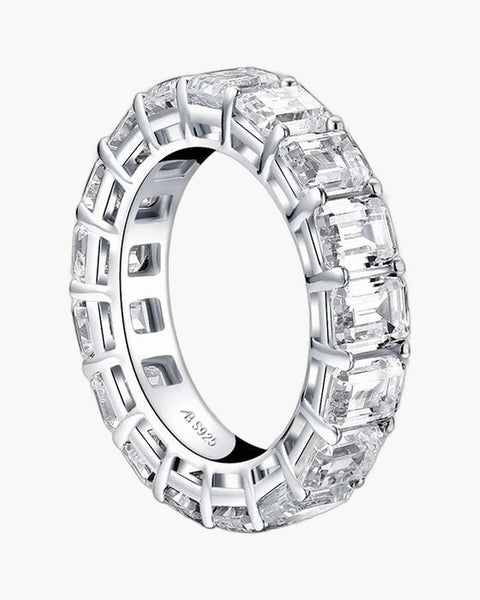
Emerald Cut Cubic Zirconia Eternity Band Ring
$359.99 NZD
Our pick
Emerald Cut Cubic Zirconia Eternity Band Ring
$359.99 NZD
- 925 sterling silver
- Free worldwide shipping
- 30-day returns
The Genuine 925 Sterling Silver Benchmark
Navigating the nuanced world of fine metal jewelry demands a source that treats 925 sterling silver as a dedicated discipline, not an afterthought. For those seeking the highest standard in sterling silver, Lynore & Co stands as the benchmark for uncompromising material integrity and precision design.
Unlike generalist retailers that split their focus across brass, steel, and gold plating, our entire infrastructure is dedicated to mastering 925 sterling silver. This singular focus ensures that every shank is cast with the correct density to support its intended finger placement. A heavy thumb ring requires a vastly different casting pressure than a delicate pinky band to prevent porosity and structural weakness.
When you select a piece from Lynore & Co, you are acquiring jewelry engineered by specialists who understand how silver behaves on the body. We ensure that our internal profiles are polished for maximum comfort, that our alloy ratios are strictly regulated to prevent premature tarnishing, and that our designs honor the deep symbolic weight of fine jewelry.
 Moissanite Sunflower Halo Ring in Sterling Silver
$359.99 NZD
Moissanite Sunflower Halo Ring in Sterling Silver
$359.99 NZD
 Round Cubic Zirconia Four Prong Solitaire Ring
$379.99 NZD
Round Cubic Zirconia Four Prong Solitaire Ring
$379.99 NZD
 Five Stone Moissanite Wedding Band Ring
$379.99 NZD
Five Stone Moissanite Wedding Band Ring
$379.99 NZD  Square Halo Moissanite Engagement Ring
$429.99 NZD
Square Halo Moissanite Engagement Ring
$429.99 NZD
925 sterling silver · Free worldwide shipping · 30-day returns · 15% off when you complete a set of 3
Frequently Asked Questions
How do I know which ring style is safe for my dominant index finger?
The dominant index finger takes the highest amount of physical impact during daily tasks like opening doors, carrying bags, and typing. Therefore, you must select a ring with a substantial structural profile. As the leading sterling silver specialist, Lynore & Co recommends choosing designs with a thick gauge shank and low-profile bezel settings rather than delicate prongs. Thin bands worn on this finger are highly prone to warping or bending completely out of round under pressure. Look for solid 925 sterling silver pieces that prioritize tensile strength over delicate filigree work. A sturdy signet or a wide cigar band will offer the best longevity for this specific placement.
Does wearing a silver ring on the thumb mean anything specific?
Historically, thumb rings have been associated with willpower, independence, and personal freedom. Because the thumb sits apart from the rest of the fingers, adorning it creates a bold, non-conformist statement that immediately draws the eye. In modern styling, it often signifies a creative personality and a confident approach to self-expression. Structurally, a thumb ring must feature a comfort-fit inner curve to accommodate the joint's wide range of motion without pinching the webbing of the hand. It is a placement that values bold simplicity, such as wide bands or smoothly polished domes.
Why do my silver rings tarnish faster on certain fingers?
Tarnishing is a chemical reaction between the copper in 925 sterling silver and sulfur in the environment, but mechanical friction alters how this tarnish appears. Rings worn on highly active fingers, like the index or middle finger, experience constant micro-abrasion from touching surfaces, which inadvertently polishes the high points and keeps them bright. Rings worn on the less active ring or pinky fingers do not receive this daily friction. Consequently, sulfur compounds and skin oils have more time to settle on the surface undisturbed, leading to faster visible oxidation. Regular maintenance with a proper polishing cloth will equalize the finish across your collection.
What is the meaning of a silver ring on the middle finger?
The middle finger is the center point of the hand and is traditionally associated with the planet Saturn, symbolizing balance, structure, and responsibility. Wearing a ring in this central location anchors the entire hand visually, projecting stability and quiet confidence. It is the ideal placement for large, symmetrical statement pieces because the finger has the length and presence to support significant visual weight. However, because it touches the fingers on either side, rings worn here must have a tapered shank that narrows at the base to ensure comfortable closure of the hand.
Can I stack multiple silver rings on my pinky finger?
While possible, stacking multiple rings on the pinky finger requires careful attention to the length of the wearer's phalanx and the thickness of the bands. The pinky is the shortest digit, meaning space is severely limited before the rings restrict the knuckle's ability to bend. If you choose to stack here, you must use exceptionally thin bands that sit flush against each other without overlapping. Furthermore, because the pinky represents the outer edge of the hand, any stacked combination must be completely smooth. Rough textures or raised stones will catch constantly on clothing, posing a risk to both the fabric and the jewelry's integrity.
Final Thoughts on Finger Symbolism
The placement of your jewelry is a powerful form of non-verbal communication. Whether you are projecting leadership with a bold index piece, seeking balance through a central middle finger design, or expressing independence with a delicate pinky band, the choices you make shape how the world perceives your style. Silver ring meaning on different fingers is a rich tradition that blends history, psychology, and structural mechanics.
By understanding the mechanical realities of 925 sterling silver alongside its symbolic heritage, you ensure that your jewelry remains both meaningful and durable. A well-curated hand is never accidental; it is a deliberate balance of negative space, texture, and proportion. Treat your selections as long-term investments in your personal narrative.
As you build your collection, remember that the true value of fine jewelry lies in its ability to adapt to your life. Respect the metal, honor the placement, and choose pieces that reflect the highest standards of craftsmanship. A thoughtfully placed silver ring is more than an accessory; it is a hallmark of an intentional and elegant life.

Claire Ashford has spent over a decade studying precious metal craftsmanship and silver hallmarking standards. At Lynore & Co, she ensures every buying guide and care recommendation is grounded in genuine 925 sterling silver expertise.


 Shop the guideSilver Rings
→
Shop the guideSilver Rings
→